25 common excuses for late payment; and how to beat them
10 September 2025
James Salmon, Operations Director
Late payment is still one of the biggest drags on UK small-business cash flow. The excuses have evolved with digital payments, but the playbook is the same: delay, deflect, and hope you give up. This refreshed 2025 guide translates the classic dodges into today’s world of bank transfers, online portals and AP automation—and shows you exactly how to respond.
Why listen to us? Since 1914, The Credit Protection Association (CPA) has helped thousands of UK businesses get paid—ethically, effectively, efficiently and economically. Our fixed‑fee membership includes Creditcare credit reports & monitoring plus an Overdue Account Recovery service that nudges your customer to pay you directly (preserving goodwill). When a case needs escalation, our collections team steps in.
How to use this guide
- Keep your tone firm, factual and polite.
- Convert open questions into closed commitments (dates, amounts, approvers).
- Log names, times, and what was promised. Follow up precisely.
- Escalate early when you sniff a stalling tactic.
The 25 excuses (2025 edition) and what to say back
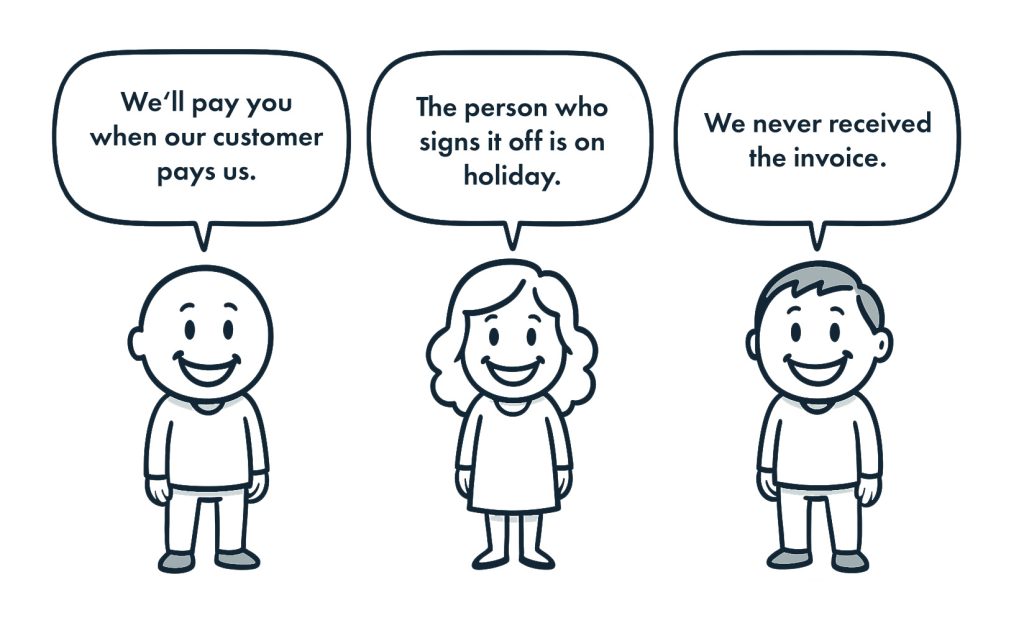
1) “We’ll pay when our customer pays.”
Debtors sometimes feel that they are entitled to withhold payment until their customers make payment to them.
If it is true, they are a victim of late payment too. But that’s no excuse for them passing it on. That’s why they call it the late payment culture! Unchecked it spreads like a disease.
Unless pay‑when‑paid was agreed in writing, their customers lack of payment is irrelevant. Ask for their debtor’s name, amount, and expected date. If you are feeling generous. offer a split: part now, balance by the stated date. Escalate to a director if they stonewall.

2) “The bank transfer’s pending.”
Transfers are near‑instant domestically. Ask for payment reference, amount, value date, and a screenshot of the completed transfer. If they “scheduled” it, ask them to release it now and email the confirmation.
If the customer is telling the truth they will generally be willing to provide the details. If they are not, the excuse will probably not be used again because of the professionalism and thorough nature of your questioning.
3) “The approver is on holiday.”
This excuse is often used during the summer months and over the Christmas and holiday periods. But it can come up any time of year really.
As in judo, such excuses given by debtors can be turned against them and used to your advantage.
Ask what arrangements have been made for emergencies and payroll. Does the approver have a deputy? Are there arrangements for approving emergency payments remotely. Ask to be treated as an emergency payment and document the exception. Diary a follow‑up for the date the approver returns and email a summary of the agreement.
4) “Raise it on our portal.”
You did. Now pin them down: Which status is blocking payment? Who moves it next? When? Ask them to manually release payment while the ticket is tidied, then send you the case/approval ID.
5) “We didn’t receive the invoice.”
Confirm the AP inbox address and resend immediately as a PDF with purchase order (PO), delivery proof, and bank details. Get them to confirm: “On receipt today, you’ll pay by [date], agreed?”
You can beat this excuse by having a policy of contacting the debtor to confirm receipt of the invoice or asking them to acknowledge it . Don’t wait until the due date to be hit with this excuse.
6) “There’s a problem with the work.”
Often mentioning a dispute regarding the work will be left as long as possible to cause as much delay in resolution and therefore the need for payment.
It’s another classic.
If there is a genuine conflict over the work done, then of course resolve it as quickly as possible so that you can receive payment.
If genuine, document the issue and agree a dated remedy. If only one invoice is disputed but others are not, insist on immediate payment of the undisputed balance. Ask for written acceptance that payment follows the fix.
You can beat this by ask for early confirmations / sign offs that they are happy with the work.

7) “There’s an error on the invoice.”
The devil is in the detail!
Get exact fields to amend and issue a corrected invoice same‑day. Keep the original due date unless the price/quantity changed. Ask for written confirmation that payment will run on the next cycle.
8) “We’re switching banks.”
Fine, but this is usually instantaneous with no interruption in service these days. —ask for the new sort code/account, the switch date, and an emergency method (card, manual CHAPS, instant transfer). If they refuse, it’s likely a stalling tactic—escalate to a director.
9) “We’re waiting for a new cheque book.”
It’s 2025. Politely decline cheques and insist on bank transfer. Provide your bank details again in the email footer and on the PDF.
10) “Cash flow’s tight—we can’t pay.”
This is where good collectors earn their wages. If your debtor has a cash flow problem then that is their problem, not yours.
Push for how much they’re short by. Then agree: shortfall date + immediate part‑payment today for the rest. Always confirm amounts and dates in writing.
11) “The PO wasn’t raised.”
POs are their internal control, not your payment condition unless your contract says so. Ask for a retrospective PO and an off‑cycle payment while the PO is created.
12) “Goods/services not received.”
Provide PODs, time sheets, job cards, acceptance emails, login logs. Get them to confirm in writing that payment follows receipt of the documents—then follow up within 24 hours.
13) “We’re in administration/liquidation.”
Are they really?
Or are they merely using it as an excuse or a scam. We’ve come across people claiming they are bankrupt or their company is insolvent just to put off creditors.
Ask for the insolvency practitioner’s name and case number. Until you’ve verified status, treat it as unproven. If verified, lodge your claim immediately; if not, treat it as a refusal and escalate.
14) “We have a 90‑day policy.”
This is a big company excuse. They have payment policies and the jobsworth will repeat them like a mantra. You need to insist on the contractual terms you agreed and threaten to take it to their manager if they don’t listen.
Your contract and UK law take precedence. If no terms were agreed, the default is 30 days from receipt. State calmly that statutory late‑payment interest, fixed‑sum compensation and reasonable recovery costs may be added on overdue invoices.
15) “We only pay at month‑end.”
This is the small business equivalent of (14)
Ask which exceptions qualify for mid‑cycle payments (there always are some). Make yours one: safety‑critical, contractual milestone, or small supplier impact. Request a same‑day manual payment.
Also if you are on 30 days then you will likely have passed one payment day already. You just have to get them to pay you early rather than late next time.
16) “Our accountant/bookkeeper is off.”
One of the very common excuses for late payment. They always seem to be sick or on holiday in places with no internet!
Ask who is deputising and whether pre‑approved payments can be released. If nobody can, escalate to a director for an exception run and confirm it by email.
Document each excuse and challenge it.

17) “The person who handled it has left.”
Blaming a leaver is a classic move, and can leave you wondering who to contact for help, but it doesn’t invalidate the debt.
Get your paperwork in order and find out who has taken over and if necessary just move up the management chain until someone takes responsibility.
18) “We’ve already paid.”
Another incredibly lazy excuse, and unless you’ve received the money into your account, it’s not really your problem if the debtor has sent payment to the wrong place.
Ask for payment date, amount, reference, and the last four digits of the account they paid. If they mis‑sent it, ask for an immediate re‑payment to the correct account and proof of recall if needed.
19) “Vendor onboarding isn’t complete.”
Ask exactly what’s missing. Provide it the same day. Request a one‑time payment while the profile finalises.
20) “Name/details don’t match.”
Confirm the legal entity (registered name/number) and address. If you trade under a name, add it as ‘trading as’ on your invoice. Reissue immediately and keep the original due date.
You can avoid this excuse by making sure you establish the name and identity of your customer upfront. Verify the address. You need the legal identity of the customer, not just a trading name. That will either be a company, in which case get the full company name and registration number; or it will be an individual, in which case get the full name and home address.
This sort of issue needs to be sorted out when the order is placed and can be difficult to resolve who the debtor is when the invoice is already late.
21) “We pay when we get paid by the end customer.”
Complex supply chains can blur liability. Make sure your contract makes the ordering party liable. If not, secure a tripartite confirmation in writing for future work—and pursue the liable entity now.
22) “Security checks on bank details.”
Welcome it. Offer a penny test or a Confirmation of Payee screenshot. Provide an on‑letterhead bank letter and a director’s confirmation.
23) “You can’t get through to anyone.”
Not so much an excuse, but a delaying tactic nonetheless!
A classic dodge. Often debtors just dodge payment by dodging you!
Try early/late calls or alternate numbers. Ask to speak to other decision makers. Send emails. LinkedIn, and the company switchboard. Ask for the Finance Director by name. Escalate to higher management. Escalate to a third party credit management company. Start adding late payment compensation and interest. Put a stop on their account. If all else fails – legal action. Don’t give in.
24) “I’m too busy / family emergency.”
Family emergencies, illness, accidents and even deaths can happen. Tragedy does strike. But does it happen every time payment is due?
Keep a record of excuses. One time you might show some understanding but habitual excuses should not be tolerated.
Keep it professional. A transfer takes minutes. Offer to stay on the line while they pay. If not possible, set a hard deadline within 24–48 hours and calendar a follow‑up.
25) “We’re not paying—do your worst.”
The most bare-faced ‘excuse’ of them all is the simple flat refusal to pay up. Good Luck!
You are left with either harassing the debtor (within the limits of the law, of course), writing off the debt, passing it to a professional debt collector (such as CPA) or taking legal action in order to recover what you are owed.
Professional debtors like this collect County Court Judgments like its a hobby so you might need to even consider bringing insolvency proceedings.
They clearly don’t have a conscience but if you make it clear you are not going to be put off and tell the debtor the extra steps you are going to take and tell them that they are going to be liable for the extra costs, the interest and the compensation then that might appeal to their wallet and prompt a reluctant payment.
Sometimes just saying “I don’t care about the cost, it is a matter of principle” can have an effect.

Make the law work for you
If your contract doesn’t set terms, UK law implies 30 days from receipt. For late payments on business‑to‑business invoices, you can claim statutory interest (8% over base), fixed‑sum compensation (£40–£100 per invoice) and reasonable recovery costs where applicable. Use these calmly, not punitively, to encourage prompt payment.
Prevention beats cure: your checklist
- E‑invoicing discipline: PO on the face, legal entity, bank details, contact emails, and delivery proof attached.
- Up‑front terms: 30 days (or better), late‑payment interest and costs, clear milestone triggers.
- Credit checks & monitoring: run Creditcare reports and set sensible credit limits; enable real‑time monitoring for status changes.
- Collections rhythm: friendly reminder 7 days before due, on‑day nudge, firm follow‑ups at +7, +14, +21. Convert waffle into dated commitments.
- Know your escalation path: when to go account‑on‑stop, when to issue an LBA, when to refer to CPA Overdue Account Recovery or Collections.
How CPA helps you get paid (and keep customers)
- Fixed‑fee membership: Creditcare reports, monitoring, address verification, and Overdue Account Recovery—which directs your customer to pay you (not us), protecting goodwill.
- 80%+ resolution at the overdue stage: most accounts settle without burning bridges.
- Ethical escalation: for the minority that don’t, our collections team escalates firmly and professionally.
- Late Payment Compensation (LPC) Recoveries: even if you were paid late in the past six years, we can help you claim compensation that’s rightfully yours.
👉 Call Peter Uwins (National Sales Manager) on 020 8846 0000 (business hours) or email nsm@cpa.co.uk.
👉 For single stubborn debts you want off your desk fast, call 020 8846 0000 and ask for Godfrey Nelson or Cris Shirley, or email debtpurchase@cpa.co.uk.
The Credit Protection Association – Prompting Punctual Payments – Ethical, Effective, Efficient, Economical collections.