The Psychology of Getting Paid: 8 Proven Techniques Every Business Should Use
Late payment is rarely just about ability to pay.
More often, it’s about behaviour.
And behaviour can be influenced.
At The Credit Protection Association, we’ve spent over a century understanding what actually drives customers to settle invoices — quickly, willingly, and without damaging relationships.
This guide brings together eight proven psychological principles that improve payment outcomes — all practical, ethical, and used every day in effective credit control.
▶ Watch the Series: The Late Payment Files
We’ve created a short video series bringing these principles to life with real-world examples.
You can watch each episode as you go through this guide.
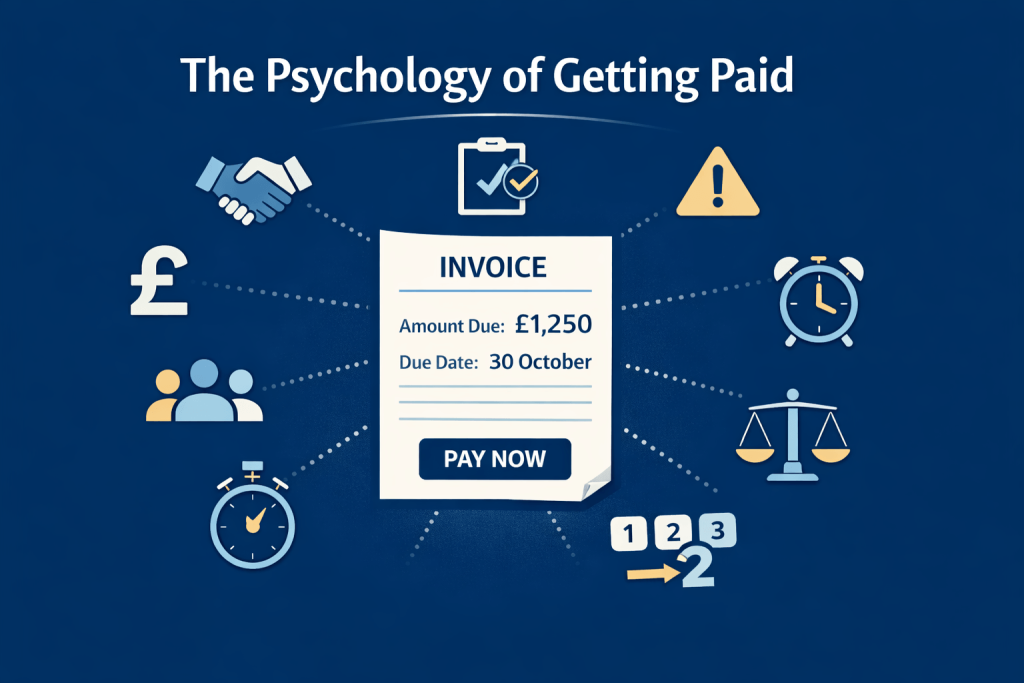
1. Reciprocity — The Favour Trade
People are more likely to act when they feel they’ve been given something first.
In credit control, this doesn’t mean being overly generous — it means being strategically flexible.
For example:
• “If you can clear this by Friday, we can accept £1,150 in full settlement.”
• “We can allow a short extension if payment is confirmed today.”
This creates a sense of balance — you’ve offered something, and they feel inclined to respond.
How to use it:
Offer small, controlled concessions in exchange for immediate action. Always link the concession to a clear outcome.
Watch Episode 1: The Favour Trade
2. Commitment & Consistency — The “Yes” Effect
Once someone commits to something small, they are far more likely to follow through.
Even a low-effort action can shift behaviour.
For example:
• “Can you reply YES to confirm we can set up a payment plan?”
• “Can you confirm you’ll make payment by Friday?”
That simple act of agreement increases the likelihood they’ll stick to it.
How to use it:
Start with a small, easy commitment — then build from there. A quick reply, a token payment, or confirmation step can unlock progress.
Watch Episode 2: The Yes Trap
3. Loss Aversion — Frame What They Avoid Losing
People are more motivated to avoid losses than to achieve gains.
So instead of focusing on benefits, focus on what they prevent.
For example:
• “Pay by Friday to avoid a £40 late fee.”
• “Payment today avoids your credit line being paused.”
• “Paying now avoids disruption to your service or deliveries.”
Loss doesn’t just mean money — it includes status, convenience, and continuity.
How to use it:
Frame your message around what the customer avoids losing — always factually and calmly, never as a threat.
Watch Episode 3: Avoid the Fee
4. Social Proof — Following the Majority
People take cues from what others are doing — especially when they’re unsure.
In credit control, this means showing that prompt payment is the norm.
For example:
• “Many of our clients pay within terms to keep their account in good standing.”
• “Most customers have already settled this billing cycle.”
• “You’re one of the last September invoices still outstanding.”
This gently positions the customer as an outlier — without confrontation.
How to use it:
Use anonymised, factual statements to show the “normal” behaviour. Avoid exaggeration — credibility is key.
Watch Episode 4: Social Proof (Carefully)
5. Authority & Credibility — Who Says It Matters
Professional, structured communication significantly increases response rates.
Authority is not about being forceful — it’s about being clear, consistent and credible.
For example:
• Include invoice numbers, due dates, and agreed terms
• Use branded templates and structured formatting
• Include a named contact and role (e.g. Credit Control Manager)
There is a clear difference between:
“Just checking in…”
and
“Invoice 7842 — Due 30 September — Now 14 Days Overdue.”
How to use it:
Remove casual language. Replace it with clear, factual communication that reflects a structured process.
This is also why communication from CPA often produces faster results — it introduces independent authority and signals that the matter is being handled professionally.
Watch Episode 5: Authority & Credibility
6. Ease & Friction — Make It Simple to Pay (Coming Soon)
The easier it is to act, the more likely it happens.
Every extra step creates friction — and friction delays payment.
For example:
• Clear subject line:
“Invoice 12345 — Outstanding £1,250 — Due 30 Oct”
• One-click payment link
• Pre-filled payment amount and reference
• Clearly visible bank details
If a customer has to search for information or complete multiple steps, they are far more likely to delay.
How to use it:
Reduce effort at every stage. Make payment the fastest, simplest action available.
(Video coming soon)
7. Timing & Reminders — Staying Visible (Coming Soon)
Customers don’t always refuse to pay — they forget, delay, or prioritise other demands.
Consistent, well-timed reminders keep your invoice visible and relevant.
For example:
• Reminder before due date
• Prompt follow-up shortly after
• Clear escalation timeline
How to use it:
Stay present without being intrusive. Consistency is more effective than intensity.
(Video coming soon)
8. Anchoring — Guiding the Decision (Coming Soon)
People make decisions more easily when given structured options.
Instead of asking, “How would you like to pay?”
offer:
• “We can do 2 payments of £600 or 4 of £300.”
Most people will choose one — often the middle-ground option.
How to use it:
Provide clear, simple choices. Remove uncertainty and guide the decision.
(Video coming soon)
Why Psychology Matters in Credit Control
Effective credit control is not about pressure.
It is about:
- Reducing resistance
- Encouraging action
- Creating clarity
- Maintaining relationships
Handled correctly, these principles help businesses get paid faster — without confrontation or escalation.
How CPA Applies These Principles for Members
CPA combines behavioural insight with structured processes to deliver consistent results.
Members benefit from:
- Overdue Invoice Recovery Service
- CreditCare reports on UK companies
- Address verification and risk intelligence
- Insolvency monitoring
- Structured escalation processes
- Reduced internal collection costs
- Improved cashflow performance
CPA’s approach is designed to politely persuade payment while protecting customer relationships — a balance many businesses struggle to achieve internally.
Strengthen Your Credit Control Today
If your current approach relies on repeated chasing, inconsistent messaging, or internal resource pressure, there is a more effective way.
CPA acts as a trusted extension of your business, helping you:
- Recover overdue invoices faster
- Reduce internal workload
- Improve cashflow stability
- Maintain trading confidence
Protect Your Cashflow. Preserve Your Relationships.
Contact us to learn how CPA can support your business with professional, ethical credit control.
Find more resources here: