UK Business News Today – 29 April 2026 | Economy, Markets & Insolvencies
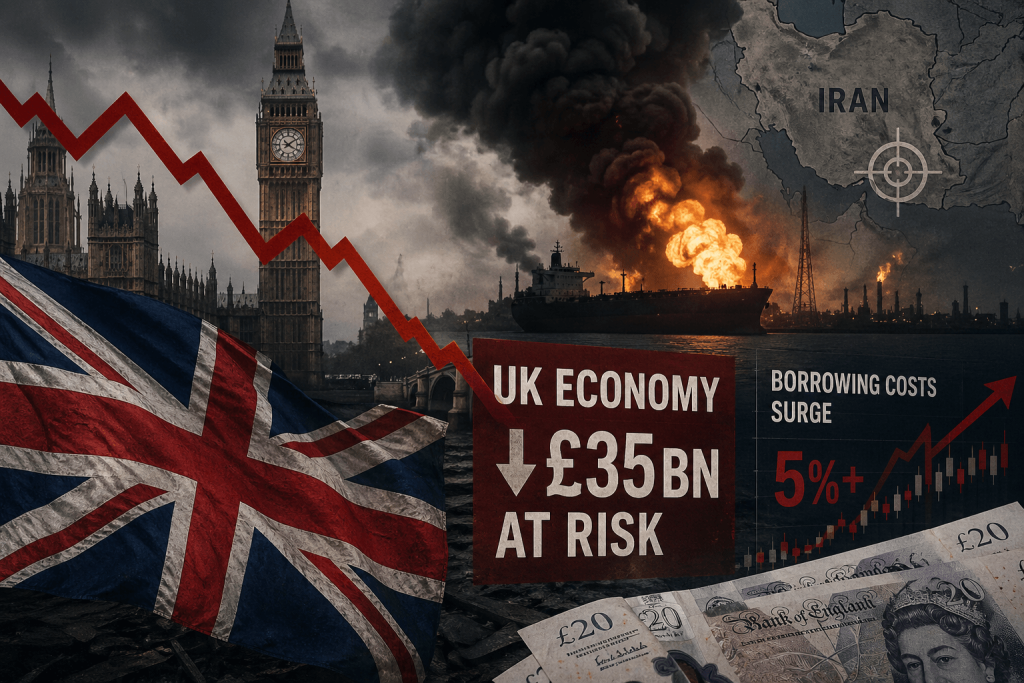
UK businesses face a tightening economic environment as the fallout from the Iran conflict continues to ripple through energy markets, inflation expectations and borrowing costs. Fresh warnings of a £35bn hit to the UK economy, rising government debt costs and growing geopolitical instability are combining to create a more uncertain outlook. For SMEs trading on credit, the message is clear: cashflow risks are increasing, and payment behaviour is likely to deteriorate as financial pressure builds across supply chains.
James Salmon, Operations Director.
Key Developments
• UK economy faces potential £35bn hit from Iran conflict
• Government borrowing costs rise to post-crisis highs
• Oil prices surge amid Hormuz blockade risks and OPEC tensions
• Consumer behaviour shifts as inflation concerns persist
• AI, employment and data risks add further business uncertainty
SME & Business Environment
UK economy faces £35bn hit from Iran conflict
The UK economy could suffer a £35bn hit due to the ongoing conflict in the Middle East, according to the National Institute of Economic and Social Research. Even under a best-case scenario, growth is expected to slow significantly, while a more severe outcome could see oil prices rise to $140 per barrel. That would likely push inflation above 5% and force the Bank of England to raise interest rates beyond current expectations, with a potential rate increase already anticipated in July.
Why it matters: Higher inflation and slower growth will tighten cashflow and increase late payment risk across SME customer bases.
Government borrowing costs surge
UK government borrowing costs have climbed to their highest levels since the 2008 financial crisis, with 10-year gilt yields moving above 5% for only the third time since the Iran conflict began. Two-year yields have risen more than 1% since March, marking the sharpest increase among developed economies. Analysts warn that the UK’s reliance on imported energy leaves it particularly exposed to external shocks.
Why it matters: Higher borrowing costs feed into lending rates, increasing financing costs for SMEs and reducing liquidity in the wider economy.
Barclays cuts UK growth forecast
Barclays has downgraded its UK growth forecast for 2026 to 1%, down from 1.1%, citing tax uncertainty and geopolitical pressures linked to the Middle East conflict. The bank also reduced its house price growth forecast to 1.9%, reflecting weaker confidence and expectations of higher interest rates. Executives also noted that UK banks face heavier tax burdens than peers in other major economies.
Why it matters: Slower growth increases the risk of delayed payments and weaker customer demand for SMEs.
House of Lords calls for stronger fiscal buffers
The House of Lords Economic Affairs Committee has warned that the UK’s fiscal position is becoming increasingly fragile, calling for a significant increase in the current £22bn fiscal buffer. The report argues that the country’s debt trajectory is unsustainable and that stronger safeguards are needed to manage future shocks. It also urged stricter adherence to fiscal rules and greater independence in policymaking.
Economy & Policy
Investment campaign faces tax criticism
Savers withdrew £3.9bn in lump sums from pensions over a 12-month period, up 29% year-on-year and 81% higher than two years earlier. The increase has been driven by speculation over potential cuts to tax-free cash allowances, demonstrating how quickly consumer behaviour can shift in response to policy uncertainty.
Pension withdrawals surge amid tax fears
Savers withdrew £3.9bn in lump sums from pensions over a 12-month period, up 29% year-on-year and 81% higher than two years earlier. The increase has been driven by speculation over potential cuts to tax-free cash allowances, demonstrating how quickly consumer behaviour can shift in response to policy uncertainty.
Energy tax cuts expand across Europe
The number of countries cutting energy taxes in response to the Middle East conflict has doubled in the past month. Governments are attempting to shield households and businesses from rising costs, despite warnings from the IMF about fiscal discipline.
Industry & Investment
Oil market tensions intensify
Brent crude is trading above $105 per barrel, with prices having briefly exceeded $111, as geopolitical tensions and potential supply disruptions persist. Analysts warn that a prolonged blockade of the Strait of Hormuz could push prices towards $120–125 per barrel. The UAE’s decision to leave OPEC adds further uncertainty to global supply dynamics.
Why it matters: Rising fuel and energy costs directly increase operating expenses and reduce profit margins for SMEs.
UAE exit from OPEC reshapes supply outlook
The United Arab Emirates will leave OPEC and OPEC+ after nearly 60 years, allowing it greater flexibility to increase production. The move could weaken OPEC’s control over supply at a critical time for global energy markets.
Global infrastructure spending set to surge
Global infrastructure spending is expected to reach $151 trillion by 2050, rising from $4.4 trillion annually to $6.9 trillion. Growth is driven by investment in transport, power and industrial systems, particularly in the US and Europe.
Corporate earnings remain mixed
Lloyds Banking Group reported Q1 profit of £2bn, beating expectations and rising 33% year-on-year, while return on tangible equity improved to 17%. GSK also reported turnover of £7.63bn and pretax profit of £2.14bn, supported by strong demand in specialty medicines.
Employment & Labour
AI threatens over 1m London jobs
More than 1m jobs in London are considered highly exposed to AI, with around 300,000 administrative roles at significant risk. Around 46% of the workforce could see tasks automated, while 7% of large businesses have already used AI to reduce staff.
Why it matters: Labour market disruption can reduce household income stability, increasing the risk of slower payments.
Youth unemployment rises sharply
More than 900,000 young people aged 18–24 are not in employment, education or training, with inactivity rising to 15%. Around 21% of this group report long-term health conditions limiting their ability to work.
Why it matters: Weak employment conditions reduce consumer spending power and increase credit risk across SME customer bases.
Technology & Compliance
AI data risks grow for UK firms
A survey found that 61% of senior tech leaders in large UK firms do not fully understand how their data is used overseas by AI systems. Nearly 75% of companies regularly transfer data abroad, raising concerns under UK GDPR rules.
Musk vs OpenAI dispute highlights governance risks
Elon Musk’s legal challenge against OpenAI centres on claims that the organisation moved away from its original non-profit structure. The case highlights broader concerns about governance and control in the fast-growing AI sector.
Consumer & Housing
London housing market slows
Homes in London are taking an average of 41 days to sell, six days longer than a year ago. Sales are down 3% year-on-year and buyer enquiries have fallen by 2%, while prices in London and the South East have declined slightly.
Why it matters: Slower housing activity reduces consumer confidence and spending, impacting SME revenues.
Grocery inflation eases but pressure remains
Grocery inflation has fallen to 3.8%, the lowest level in a year, while take-home sales rose just 0.9%. However, shoppers are increasingly relying on promotions due to ongoing concerns about rising costs linked to global events.
Why it matters: Continued price sensitivity suggests customers may delay payments or prioritise essential spending.
Financial Services
Lloyds tops FCA complaints list
The FCA recorded 1.9 million complaints in the second half of 2025, with Lloyds Banking Group accounting for 187,516 of them. Motor insurance complaints rose by more than a third, while compensation paid fell to £236.2m.
Global Market Summary
Global markets remain dominated by the fallout from the Iran conflict, with energy prices, inflation expectations and central bank policy all in focus.
Equities
European markets were mixed. The FTSE 100 fell around 0.3% to 10,287, dragged lower by financial stocks, while the STOXX Europe 600 was broadly flat at 605. The DAX held firm at 24,060 and the CAC 40 stood at 8,086.
In the US, markets were cautious ahead of the Federal Reserve decision. The S&P 500 closed at 7,138, the Dow Jones at 49,141 and the Nasdaq at 24,663.
Asian markets performed better overnight, with the Nikkei 225 at 59,917 and the Hang Seng rising to 26,114, supported by strong corporate earnings.
Market Drivers
The dominant driver remains the Middle East conflict, with fears of a prolonged disruption to oil supply. The potential blockade of the Strait of Hormuz and the UAE’s exit from OPEC are adding to uncertainty.
Central bank decisions are also in focus, with the Federal Reserve expected to hold rates but signal how it will respond to rising energy-driven inflation.
Currencies
Sterling is trading at 1.3505 against the US dollar and 1.153 against the euro. Currency markets remain relatively stable but sensitive to interest rate expectations and bond market movements.
Commodities
Brent crude is trading above $105 per barrel, with WTI near $101, reflecting ongoing geopolitical risk.
Gold remains elevated at around $4,586 per ounce, supported by safe-haven demand and central bank buying.
Rising commodity prices are reinforcing inflation concerns and increasing cost pressures globally.
Insolvency Watch
Administrations (4)
• RK9 Security Services Ltd
• Scan-Thors (U.K.) Limited
• Stephen Tyler Limited
• Surface Transforms PLC
Liquidations (12)
• Axolotl Technologies Ltd
• Field Leaders Limited
• Fintrain Ltd
• G S Food Supermarket Limited
• Gracefield Consulting Limited
• Iris Topco (UK) Limited
• JC Walker Concepts Ltd
• Maranar Limited
• RMC Tech Ltd
• Splendid Property Company Limited
• UK Leasing Leicester Ltd
• Wide Choice Limited
Winding-up Petitions (10)
• AES Mechanical Ltd
• Alexander Oastler Limited
• BDM GRP Ltd
• Burger and Buns Ltd
• Garmony Holdings Limited
• GMEK Housing Consortium Ltd
• Heat Pump Devon Ltd
• M H Davies Construction Limited
• On Point Building & Joinery Ltd
• Pennine Electrical Solutions Ltd
• Prestige Commercial Maintenance Services Limited
What CPA can do for you
Rising costs, higher interest rates and increasing insolvencies are creating a more challenging environment for businesses that trade on credit. When customers face pressure, payment delays often follow.
CPA helps you stay ahead of that risk.
From CreditCare reports that highlight financial warning signs, to ongoing debtor monitoring and professional recovery of overdue accounts, CPA gives you greater visibility and control over your cashflow.
Early action is key. The sooner a potential issue is identified, the easier it is to resolve while preserving the relationship.
To find out how CPA can support your business, call 020 8846 0000 (business hours) or email PaidQuick@cpa.co.uk today.
When you see your money come in, you will be so glad you used CPA.
The Credit Protection Association – Prompting Punctual Payments – Ethical, Effective, Efficient, Economical collections.
Open this guide in a new tab
.